
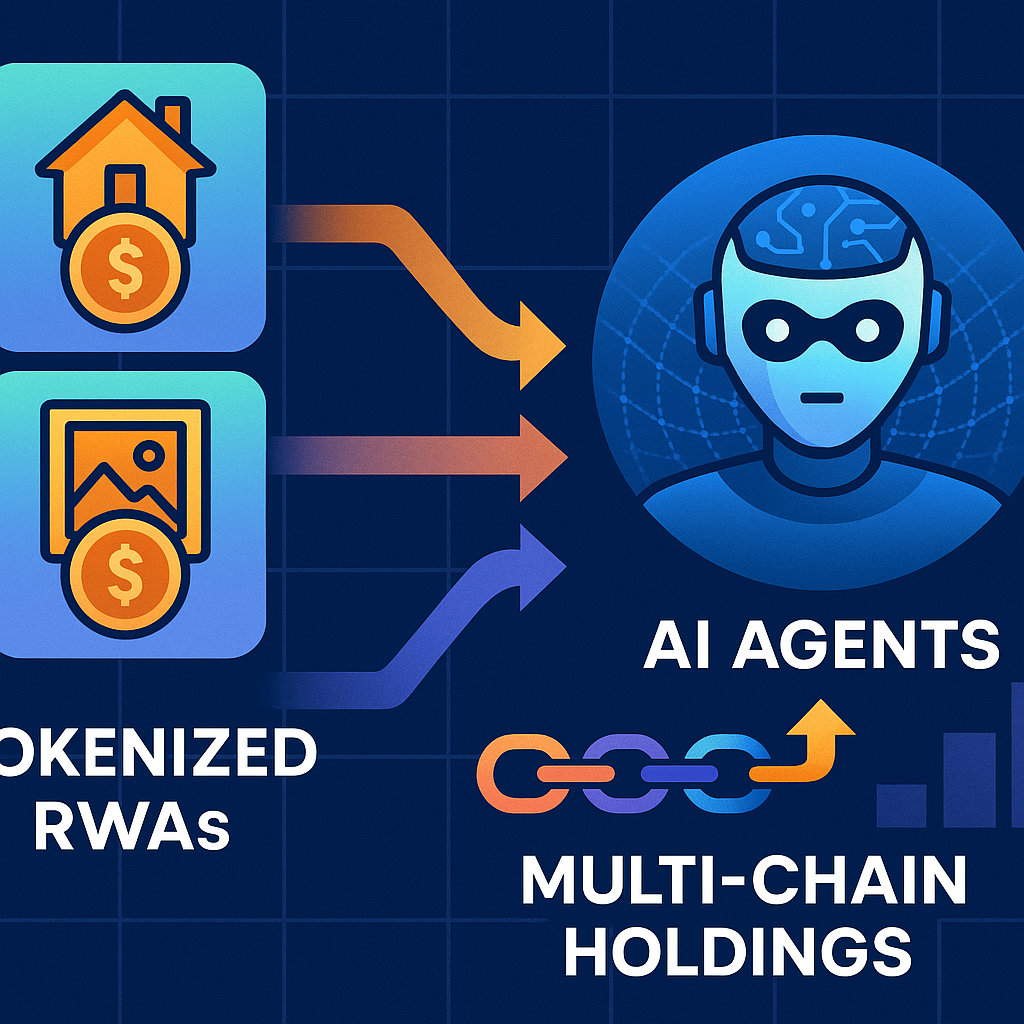
What’s Coming Next
Key Takeaways
- The tokenized RWA market reached $30B in Q3 2025 and is projected to hit $612B by year-end
- 10-20 new platforms launching across commercial real estate, tokenized bonds, infrastructure, and international markets
- Major regulatory frameworks (MiCA, Project Guardian, VARA) enabling institutional participation
- Securitize’s $1.25B public listing (H1 2026) signals mainstream legitimacy
- New platforms carry high risk—thorough due diligence essential
- By 2026, RWA market could be 5-10x larger than today
Introduction: The Next Wave of RWA Tokenization
While Lofty, RealT, and Reental pioneered tokenized real estate for retail investors, a new wave of RWA platforms is preparing to launch in 2025-2026. These next-generation platforms promise to expand beyond residential real estate into commercial properties, infrastructure, tokenized bonds, and fine art—potentially opening trillion-dollar markets to everyday investors.
The tokenized real-world asset market has crossed a critical threshold. As of Q3 2025, tokenized assets exceeded $30 billion in total value, driven by institutional demand for yield-bearing products and regulatory clarity in major jurisdictions. This represents a fundamental shift from experimental proof-of-concepts to enterprise-grade products. The market is projected to reach $612.71 billion by the end of 2025 and could grow to $9.43 trillion by 2030.
What makes 2025-2026 unique is not just the volume of capital or platforms entering the space, but the institutional legitimacy, regulatory frameworks, and infrastructure now supporting tokenization. Traditional finance giants—BlackRock, Franklin Templeton, Fidelity, and Goldman Sachs—are no longer watching from the sidelines. They’re building tokenized products and integrating blockchain into their operations. Simultaneously, regulatory bodies in the US, EU, UK, Singapore, UAE, and Australia have moved from skepticism to active framework-building, creating the conditions for sustainable growth rather than speculative hype.
Part 1: The Current RWA Landscape in 2025
Where We Are Now
The established platforms that pioneered retail access to tokenized real estate remain relevant but face distinct pressures. Lofty operates roughly 150 properties across 40 US markets with approximately $50 million in assets under management, allowing investors to begin with just $50 tokens and earn daily rental income. RealT, while once ambitious in scale, has faced operational challenges and is currently navigating a more cautious market. Reental operates on a smaller scale, primarily focused on European residential properties.
Collectively, these established platforms manage somewhere in the $200-300 million range globally—significant for a nascent market but representing less than 1% of the addressable opportunity. The current tokenized real estate market itself stands at roughly $10 billion, or approximately 33% of the broader $30 billion RWA market.
Why New RWA Platforms Are Emerging Now
Three structural forces are colliding to create this moment:
Regulatory Clarity: The EU’s MiCA (Markets in Crypto-Assets) regulation, Project Guardian pilots in Singapore and Australia, the UAE’s VARA framework, and the US’s emerging guidance through the GENIUS Act and Project Crypto are providing institutional-grade legal structures for tokenization. This clarity is essential—without it, institutional capital remains sidelined by compliance uncertainty.
Institutional Capital Seeking Yield: Traditional yield-generating instruments offer reduced returns. Fixed-income securities yield 4-5%, while tokenized real estate can generate 6-10% cash yields plus potential appreciation. This differential is attracting capital from family offices, pension funds, and alternative asset managers that need better returns in a low-rate environment.
Technology Maturation: Layer 2 blockchains (Arbitrum, Optimism, Base, ZKSync) have dramatically reduced transaction costs and settlement times. Multi-chain infrastructure allows institutional-grade digital asset custody through firms like Copper and Anchorage. Cross-chain bridges enable liquidity across ecosystems. These technological advances were essential preconditions that are now in place.
Proven Business Models: Figure Technologies, which tokenizes consumer loans on the Provenance blockchain, has demonstrated the viability of the underlying model. The company now dominates private credit tokenization with approximately 75% of the $17 billion tokenized private credit market and has originated $5.1 billion in home equity lines of credit as the top independent HELOC lender in the US. This success story has validated the entire sector to institutional investors and regulators alike.
Part 2: Categories of New RWA Platforms Launching
Category 1: Commercial Real Estate Tokenization Platforms
What’s Emerging
While residential real estate tokenization remains niche, commercial real estate represents an entirely new frontier for RWA platforms. Zoniqx, RealBlocks, SolidBlock, and emerging platforms are positioning themselves to tokenize office buildings, retail centers, industrial warehouses, and mixed-use developments valued at $10 million to $100 million per property.
RealBlocks, for example, is building a white-label platform specifically designed for institutional-grade commercial real estate tokenization, enabling developers and asset managers to raise capital through tokenized private placements with built-in secondary trading mechanisms.
Why Commercial Real Estate Matters
Commercial real estate represents a $20+ trillion global market. Institutional-grade properties typically generate 6-10% net yields, comparable to residential but with different risk characteristics—longer lease terms (5-10 years vs. 1-year residential), professional tenants, and diversified revenue streams across property types.
More importantly, commercial real estate tokenization appeals to institutional investors in ways residential does not. A single class-A office building in a major metro can be valued at $50-200 million, attracting institutional capital that finds Lofty’s $50 tokens unsuitable. Tokenizing this property into $1,000-$5,000 tokens makes it accessible to family offices and institutional side pockets without fragmenting ownership excessively.
Challenges and Timeline
The commercial sector faces headwinds. Remote work has pressured office valuations. Interest rates remain elevated, affecting development economics. Additionally, commercial properties require more sophisticated due diligence—tenant credit analysis, lease structure evaluation, market dynamics—than residential homes. New RWA platforms must build institutional-grade risk assessment capabilities.
Expect the first wave of commercial real estate platforms to launch in Q4 2025 through Q2 2026, likely focusing on Class A properties in major metropolitan areas (New York, Los Angeles, London, Singapore, Dubai). Initial offerings will probably be for accredited and institutional investors only, with retail access potentially expanding as regulatory frameworks solidify.
Category 2: Tokenized Bonds and Fixed Income Platforms
What’s Launching
Tokenized US Treasuries have already proven this model, with the market reaching $7.45 billion as of August 2025—a 256% increase year-over-year. Platforms like Ondo Finance, OpenEden, Superstate, and Circle’s USYC have established that institutional and retail investors prefer 24/7 blockchain-based access to US government debt over traditional settlement mechanisms.
Ondo Finance recently expanded its Ondo Global Markets platform to BNB Chain in October 2025, bringing over 100 tokenized US stocks and ETFs to international investors, building on its September 2024 Ethereum launch that attracted $350 million in total value within weeks.
OpenEden has scaled TBILL (tokenized Treasury Bills) to over $286 million in TVL and now issues EDEN, its ecosystem governance token, as it enters the next phase of growth.
What’s new for 2026 is expansion beyond US Treasuries into corporate bonds, municipal bonds, and international government debt (German bunds, Japanese government bonds, etc.). Mountain Protocol’s USDM offers a yield-bearing stablecoin collateralized by short-term US Treasuries, demonstrating how tokenization creates composability with DeFi protocols.
Why Tokenized Bonds Are Transformative
The global bond market exceeds $130 trillion. Yet retail investors face substantial barriers: minimum purchases of $1,000-$5,000 per bond, dealer intermediation, T+2 settlement delays, and limited trading hours. Tokenization eliminates all of these. A tokenized bond can be purchased in $10 increments, settled in seconds, and traded 24/7.
From an institutional perspective, 24/7 trading enables carry trades and dynamic hedging strategies impossible in traditional bond markets. BlackRock’s BUIDL fund (USD Institutional Digital Liquidity), the largest tokenized asset product at $2.38 billion, demonstrates institutional appetite for on-chain fixed income.
Challenges and Timeline
Regulatory complexity remains substantial. Corporate and municipal bonds involve securities law considerations distinct from government debt. International bonds require custodial arrangements in multiple jurisdictions. However, regulatory progress is accelerating. By Q2 2026, expect 3-5 new municipal bond tokenization pilots in the US and expanded corporate bond offerings across Europe.
Category 3: International and Emerging Market RWA Platforms
What’s Launching
Brazil launched the world’s first tokenized real estate exchange (bolsa imobiliária tokenizada) in June 2025, involving 100 developers, 10,000 agents, and 100 tokenized projects in its initial phase. This is not a pilot—it is a regulated exchange with material institutional participation.
Hong Kong is positioning itself as a hub for tokenized real estate connecting international investors to Asian properties. In September 2025, China New City Group partnered with Hong Kong platform EXIO to tokenize a commercial property, facilitating cross-border investment flows previously blocked by regulatory barriers.
Asia Pacific broadly is accelerating. Singapore continues its Project Guardian sandbox work. Japan is piloting real estate tokenization. Thailand has completed commercial building tokenizations. South Korea tested fractional public asset ownership. The region’s combination of high property values, tech-savvy populations, and regulatory clarity creates optimal conditions for tokenization platforms.
Latin America beyond Brazil is nascent but moving. Mexico, Colombia, and other markets are exploring frameworks. These represent high-growth opportunities—emerging market real estate often yields 8-12% compared to US 5-6%—with currency diversification benefits for international investors.
Why Geographic Expansion Matters
New RWA platforms targeting LATAM, Asia, and Africa tap markets where traditional real estate access is limited by capital controls, local currency weakness, or institutional dysfunction. A Brazilian developer can tokenize a Rio property and immediately access global capital without the friction of international wiring or cross-border fund structuring. This unlocks trillions in assets from markets that have historically been inaccessible to retail international investors.
However, geographic expansion carries risks: currency volatility, political stability concerns, local regulatory ambiguity, and the practical challenge of property management and due diligence across borders.
Timeline and Outlook
2-3 major international expansion platforms will launch targeting LATAM and Asia in Q1-Q2 2026. These will likely be backed by teams with regional expertise and local partnership networks, not just blockchain engineers transplanting a model across borders.
Category 4: Infrastructure and Alternative Asset Platforms
What’s Launching
Renewable energy tokenization is accelerating. WePower, Energy Web Token (EWT), and emerging platforms are tokenizing solar farms, wind turbines, and EV charging networks. These projects offer 6-10% yields from energy generation and revenue, plus ESG appeal.
Fine art tokenization remains speculative but maturing. Masterworks has demonstrated the model (fractional ownership, illiquidity constraints, institutional-grade appraisals). New platforms are emerging to tokenize broader art categories and enable peer-to-peer secondary markets. The digital artwork market was valued at $5.8 billion in 2025 and is projected to reach $17.72 billion by 2032.
What This Category Offers
Infrastructure assets appeal to institutions seeking diversification and ESG mandate compliance. A solar farm generates contractual cash flows (power purchase agreements) that can be tokenized and traded, providing institutional-grade collateral.
Fine art tokenization remains highly speculative. Most art tokenization platforms to date have focused on blue-chip artworks (Monets, Picassos) appealing to wealthy collectors. Secondary market liquidity for art remains theoretical. Art valuations are subjective, custody is complex, and fraud risk is elevated. This category should be viewed as experimental.
Realistic Assessment
2-3 legitimate infrastructure platforms will launch in 2026. Fine art tokenization will see continued experimentation but should be considered high-risk, lower-opportunity relative to real estate, bonds, or private credit. For most RWA investors, alternatives in other categories offer better risk/return profiles.
Category 5: Institutional Infrastructure and Multi-Asset Platforms
What’s Launching
Securitize, the leading tokenization infrastructure provider, announced in October 2025 that it will go public via merger with Cantor Equity Partners II at a $1.25 billion pre-money valuation, with listing expected in H1 2026 on Nasdaq under the ticker SECZ. This is historically significant: Securitize will become the first publicly traded company dedicated to securities tokenization infrastructure.
Securitize has already tokenized over $4 billion in assets, serves institutional partners including BlackRock, Apollo, Hamilton Lane, and VanEck, and operated as the transfer agent for BlackRock’s BUIDL fund (the largest tokenized asset product).
Figure Technologies, which merged with Figure Markets in July 2025, is combining consumer loan origination with a blockchain-native asset exchange, creating an integrated platform for tokenizing loans and trading them on-chain.
What These Platforms Mean for RWA Investors
These are the plumbing layers—not consumer-facing platforms, but infrastructure that enables other platforms to operate at scale. Securitize’s public listing sends a powerful signal to institutions: tokenization is no longer fringe, it’s foundational infrastructure for capital markets.
For RWA investors, the significance is indirect but powerful. Institutional infrastructure platforms improve custody, compliance automation, secondary market liquidity, and interoperability—making all consumer-facing RWA platforms safer, more efficient, and more liquid.
Quick Guide: Which New RWA Platform Type Is Right for You?
If you’re interested in stability and yield:
→ Tokenized bonds (Ondo, OpenEden expanding)
→ Lower risk, 4-5% yields, high liquidity
If you want real estate diversification:
→ Commercial RE platforms (launching Q4 2025-Q2 2026)
→ Medium risk, 6-10% yields, longer hold periods
If you want higher returns and can handle risk:
→ International/emerging market platforms (Brazil, Asia focus)
→ Higher risk, 8-12% yields, currency/political risk
If you’re sophisticated and want cutting edge:
→ Infrastructure and alternative assets (renewable energy, art)
→ High risk, experimental, 6-15% potential yields
For most investors: Start with established platforms (Lofty, Ondo) and only allocate 10-20% to new platforms as they prove themselves. Learn more about building a diversified RWA portfolio.
Part 3: What This RWA Expansion Means for Investors
Opportunities
Genuine Diversification Beyond Established Platforms
For investors who have maxed out on established platforms, new RWA platform launches offer real optionality. Instead of 3-4 platforms, investors will be able to choose from 15-25 platforms spanning residential, commercial, international, bonds, and alternatives. A sophisticated investor could build a diversified RWA portfolio: 30% US residential (Lofty), 20% commercial (new platform), 30% tokenized Treasuries (Ondo/OpenEden), 15% infrastructure, 5% fine art.
Better Technology and User Experience
Early platforms were built in a pioneer mindset. New entrants are learning from these lessons and building with institutional standards from day one. Expect superior UX, better portfolio tracking, integrated custody solutions, and seamless cross-platform liquidity.
Improved Liquidity in RWA Markets
As the market expands to $600 billion+ by end of 2025, secondary markets will deepen. More buyers and sellers mean tighter spreads, faster execution, and less price impact when exiting positions. Early-stage platforms like Lofty sometimes show 10-20% price spreads between bid-ask; mature markets compress this dramatically.
Institutional Capital Participation
As institutions allocate capital to tokenized assets, they bring sophisticated risk management, regulatory oversight, and stability. This “halo effect” raises standards across the industry and makes individual platforms more resilient to operational failures.
Challenges and Realistic Cautions
Unproven RWA Platforms
New platforms equal new operational risk. Backend security, custody arrangements, compliance execution, property management—all are unproven. A platform could face infrastructure failures, regulatory enforcement actions, or outright fraud. Historical precedent from other fintech waves shows that 30-50% of new entrants fail within 5 years.
Market Timing Risk
Several RWA platforms launching in late 2025 and 2026 are entering real estate during a period of elevated interest rates and macro uncertainty. Commercial real estate faces particular headwinds. Institutional investors are cautious on real estate valuations. Some of these platforms may find capital raising more difficult than anticipated, leading to delays or scaled-back launches.
Regulatory Risk
While regulatory progress has been real, it is far from complete. The SEC could issue enforcement actions against platforms offering securities without proper registration. Foreign regulators could crack down on cross-border offerings. Unproven jurisdictions (Brazil’s new exchange, Hong Kong’s emerging framework) could face reversals or unexpected constraints.
Fragmentation Risk
As the number of RWA platforms proliferates, managing a diversified RWA portfolio becomes burdensome. Each platform has different fee structures, redemption timelines, tax reporting, and user interfaces. There is no unified dashboard (yet). Portfolio rebalancing becomes operationally complex.
Due Diligence Burden
With legitimacy becoming less clear as platforms multiply, investors must perform deeper due diligence. Team backgrounds, regulatory status, custody arrangements, insurance coverage, and fee structures must all be carefully vetted. Early movers willing to conduct this work will benefit; casual investors will face higher failure risk. See our guide on how to research tokenized properties for due diligence frameworks.
Part 4: How to Evaluate New RWA Platforms
Critical Questions to Ask Before Investing
1. Who is behind this RWA platform?
- Does the team have relevant experience? (Real estate, crypto, fintech backgrounds?)
- Have founders successfully exited previous companies?
- Are advisors recognizable names in traditional finance or fintech?
- Does the cap table include reputable VCs or institutions?
Red flag: Anonymous founders, no professional track record, or advisors with questionable backgrounds.
2. What is the regulatory status?
- Is the platform licensed in any major jurisdiction?
- Which specific regulations does it claim to comply with?
- Has it obtained SEC or equivalent foreign regulatory approval?
- What is the legal structure for asset ownership? (Special purpose vehicle, trust, fund structure?)
Red flag: Vague regulatory language, operating in jurisdictions with no framework, or claiming to be “unregulated” as a selling point.
3. Has the team shipped before?
- Operating only on testnet or mainnet with real assets?
- Do successful projects or completed tokenizations exist?
- Is the platform actually live or still in beta after 2+ years?
- What do early users say (not cherry-picked testimonials)?
Red flag: Indefinite beta status, delays slipping repeatedly, or no real-world completed transactions.
4. How does custody work?
- Who holds the actual real-world assets?
- Is a qualified custodian involved?
- What happens if the platform shuts down?
- Is the custodian insured and audited?
- Can you access assets directly if the platform fails?
Red flag: Unclear custody chain, platform itself acting as custodian, or no insurance coverage.
5. What are all-in fees?
- Entry fees, trading fees, exit fees, platform management fees?
- Performance fees if applicable?
- Are there hidden costs (custody, insurance, valuation)?
- How do total fees compare to traditional alternatives?
Red flag: Headline yield of 10% but 4% in fees (net 6%), or fee structure deliberately obscured.
6. How liquid is it really?
- Does a secondary market exist or is it promised?
- How long does liquidity take? (Hours, days, weeks?)
- What’s the realistic bid-ask spread?
- Under stressed market conditions, is liquidity reliable?
Red flag: Secondary markets promised but not yet built, or liquidity only to related parties.
Red Flags and RWA Platforms to Avoid
Avoid platforms that:
- Promise yields >15% without clear explanation of how those yields arise
- Operate with anonymous teams or teams lacking verifiable history
- Claim complete regulatory exemption as a feature
- Have no articulated custody or insurance plan
- Have been in “beta” or “coming soon” for 12+ months
- Pressure you to “invest now before launch” or use scarcity language
Beware of:
- Centralized exchanges listing RWA tokens without proper vetting
- Platforms that issue their own governance tokens heavily—sometimes this is sign of project needing liquidity vs. legitimate tokenomics
- Geographic arbitrage claims (e.g., “10% yield in Brazil”) without explaining currency/political risk
For comprehensive risk analysis, see our guide on RWA investment risks.
Part 5: The 2025-2026 RWA Market by Numbers
Market Size Projections
As of Q3 2025, tokenized RWAs reached $30-33 billion. By end of 2025, the market is expected to reach $612.71 billion. By 2030, projections range from $1.4 trillion to $9.43 trillion depending on adoption assumptions.
RWA Platform Launch Timeline
Late 2025 (Q4):
- 2-3 commercial real estate tokenization platforms
- 1-2 expanded tokenized bonds offerings (corporate bonds beyond Treasuries)
- 1 infrastructure tokenization platform
Q1-Q2 2026:
- 2-3 international expansion platforms (Brazil follow-ups, Asia-focused platforms)
- 1-2 additional alternative asset platforms (fine art, commodities)
- Securitize’s Nasdaq listing (expected H1 2026)
Q3-Q4 2026:
- Secondary market maturation and cross-platform liquidity infrastructure
- Regulatory sandbox completions (potentially leading to broader approvals)
- Institutional fund launches incorporating tokenized assets
Capital Requirements and Unit Economics
Most platforms raising 2025-2026 will target $30-100 million in seed/Series A funding. Securitize’s public market valuation ($1.25 billion) represents an outlier and signals institutional confidence in the infrastructure layer.
Property tokenization platforms require significant due diligence and custody infrastructure—not just technology. Expect capital efficiency to be lower than pure software businesses but higher than traditional real estate development.
Part 6: Regional and Regulatory Outlook for RWA Platforms
United States
Regulatory progress is incremental but real. The GENIUS Act provides framework for digital securities. Project Crypto offers guidance on tokenization within existing frameworks. However, retail access to many tokenized assets remains restricted by accredited investor requirements.
The US market is likely to see 5-7 new RWA platforms launch through 2026, with commercial real estate and tokenized bonds as primary focus. Institutional adoption will accelerate ahead of retail mainstream adoption.
European Union
Europe is establishing itself as the preferred jurisdiction for compliant tokenization. Switzerland (DLT Act since 2021), Germany (eWpG), Luxembourg, and the EU DLT Pilot Regime provide legal clarity that US frameworks have not yet achieved. Multiple European platforms will launch in 2026 targeting EU/UK markets.
Asia Pacific
Singapore (Project Guardian), Australia (Project Acacia), Hong Kong, Japan, and Thailand are all actively enabling tokenization pilots. This region will see the most explosive platform launches 2025-2026, driven by high property values, strong tech infrastructure, and pro-innovation regulatory positioning. Asia Pacific could represent 30-40% of new RWA platform launches.
Middle East and Africa
The UAE (ADGM, VARA frameworks) and Saudi Arabia are positioning themselves as global tokenization hubs, attracting platforms and capital. Limited platforms but high capital concentration expected.
Part 7: Critical Disclaimers and Risk Factors
What Could Go Wrong
Regulatory Reversal: The SEC, FCA, or other regulators could issue enforcement actions against tokenization platforms, effectively halting growth. Political changes or negative legislative actions could restrict retail access.
Market Downturn: If traditional real estate or credit markets experience significant stress, all tokenized assets would face downward pressure. Illiquidity in primary markets would translate to illiquidity in secondary tokenized markets.
Technology Risk: Smart contract vulnerabilities, custody failures, or cross-chain bridge exploits could lead to asset loss.
Operational Risk: New platforms could fail due to poor property management, fraud, or simple incompetence. Early cryptocurrency businesses failed at high rates.
Adoption Failure: Despite infrastructure improvements, retail adoption could stall if user education remains poor or transaction friction remains high.
This Article Is Educational, Not Investment Advice
This article explores emerging RWA platforms and opportunities in RWA tokenization. It is not investment advice. Tokenized assets are experimental, early-stage investments with substantial downside risk. Many platforms launching in 2025-2026 will fail. Some may be outright fraudulent.
Important reminders:
- Conduct thorough due diligence before investing in any new platform
- Only invest capital you can afford to lose completely
- Diversify across established and new platforms
- Understand custody, regulatory, and operational risks
- Do not invest based on yield promises alone
- Consult licensed financial advisors before making investment decisions
Realistic Expectations for RWA Growth
By end of 2026, the RWA market could reach $1+ trillion, a 30-50x increase from today. This would represent a major structural shift in capital markets. However, this growth is not assured. Platforms will fail. Valuations will fluctuate. Regulatory uncertainty will persist.
The next 18 months will determine whether tokenization becomes mainstream financial infrastructure or remains a niche opportunity. For sophisticated investors willing to conduct proper due diligence and manage risk, the opportunity is genuine. For casual investors seeking “get rich quick” plays, the risks are substantial.
Conclusion: A Turning Point for RWA Finance
The 2025-2026 period represents an inflection point for real-world asset tokenization. The foundational layer—regulatory frameworks, institutional infrastructure, technical maturity, and market proof-of-concept—is now in place. What follows is consolidation, refinement, and scale.
New RWA platforms launching will not all succeed. The industry will experience shakeouts, failures, and regulatory setbacks. However, the secular trend toward tokenization is clear and powerful. Traditional finance and blockchain are converging. Capital markets are moving on-chain.
For RWA investors, this expansion offers genuine opportunity to diversify beyond established platforms, access new asset classes, and participate in markets previously inaccessible to retail investors. The key is disciplined due diligence, realistic risk assessment, and willingness to start small with new entrants while diversifying across proven platforms.
The future of capital markets is being built in 2025 and 2026. Investors paying close attention to platform launches and regulatory developments will be positioned to benefit from this structural transformation.
Related Articles:
- What Are Real-World Assets (RWAs)? Complete Guide
- How to Research Tokenized Properties Before Investing
- RWA Investment Risks: What Can Go Wrong
- Building a Diversified RWA Portfolio
- Best RWA Platforms by Yield (Updated Monthly)
Article Update Log:
- October 31, 2025: Initial publication on new RWA platforms launching 2025-2026
- Next update: November 30, 2025 (monthly updates tracking platform launches)
Have questions about new RWA platforms? Share in comments below.




Leave a Reply